Where Can I Go Horseback Riding Near Me
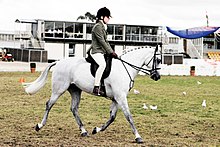
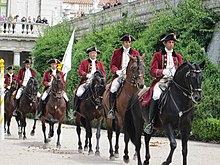
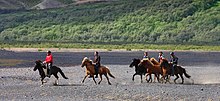
Equestrianism (from Latin equester , equestr- , equus , 'horseman', 'horse'),[2] normally known as horse riding (British English) or horseback riding (American English),[3] includes the disciplines of riding, driving, and vaulting. This broad description includes the use of horses for practical working purposes, transportation, recreational activities, artistic or cultural exercises, and competitive sport.
Overview of equestrian activities [edit]

Horses are trained and ridden for practical working purposes, such as in law work or for decision-making herd animals on a ranch. They are also used in competitive sports including dressage, endurance riding, eventing, reining, bear witness jumping, tent pegging, vaulting, polo, horse racing, driving, and rodeo (see additional equestrian sports listed later in this article for more examples). Some pop forms of contest are grouped together at equus caballus shows where horses perform in a wide variety of disciplines. Horses (and other equids such as mules) are used for non-competitive recreational riding, such every bit play tricks hunting, trail riding, or hacking. There is public access to equus caballus trails in almost every office of the world; many parks, ranches, and public stables offer both guided and independent riding. Horses are also used for therapeutic purposes both in specialized para-equestrian competition too every bit non-competitive riding to improve man wellness and emotional development.
Horses are also driven in harness racing, at horse shows, and in other types of exhibition such equally historical reenactment or ceremony, often pulling carriages. In some parts of the world, they are still used for practical purposes such as farming.[4]
Horses continue to exist used in public service, in traditional ceremonies (parades, funerals), police and volunteer mounted patrols and for mounted search and rescue.
Riding halls enable training of horse and rider in all weathers also as indoor competition riding.
History of horse apply [edit]
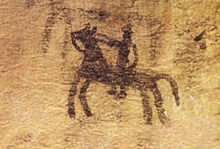
Prehistoric cave painting, depicting a horse and rider
Though there is controversy over the exact date horses were domesticated and when they were first ridden, the best judge is that horses start were ridden approximately 3500 BC. Indirect evidence suggests that horses were ridden long earlier they were driven. There is some bear witness that about 3,000 BC, virtually the Dnieper River and the Don River, people were using bits on horses, as a stallion that was cached in that location shows teeth wearable consequent with using a bit.[5] However, the most unequivocal early archaeological evidence of equines put to working use was of horses being driven. Chariot burials about 2500 BC present the most directly hard evidence of horses used as working animals. In ancient times chariot warfare was followed by the utilise of state of war horses as lite and heavy cavalry. The horse played an of import role throughout human history all over the globe, both in warfare and in peaceful pursuits such as transportation, trade and agriculture. Horses lived in North America, but died out at the end of the Water ice Historic period. Horses were brought back to Northward America by European explorers, beginning with the second voyage of Columbus in 1493.[6] Equestrianism was introduced in the 1900 Summer Olympics as an Olympic sport with jumping events.
Horse racing [edit]
Humans announced to have long expressed a desire to know which horse or horses were the fastest, and horse racing has ancient roots. Gambling on equus caballus races appears to go paw-in paw with racing and has a long history as well. Thoroughbreds accept the pre-eminent reputation as a racing breed, but other breeds too race.
Types of horse racing [edit]
Under saddle:
- Thoroughbred horse racing is the most popular form worldwide. In the Great britain, information technology is known as flat racing and is governed past the Jockey Club in the Great britain. In the United states, horse racing is governed by The Jockey Club. other light breeds are also raced worldwide.
- Steeplechasing involves racing on a rails where the horses also spring over obstacles. Information technology is most mutual in the UK, where it is also called National Hunt racing.
In harness:
- Both light and heavy breeds as well equally ponies are raced in harness with a sulky or racing bike. The Standardbred dominates the sport in both trotting and pacing varieties.
- The United States Trotting Association organizes harness racing in the United States.
- Harness racing is likewise found throughout Europe, New Zealand and Australia.
Distance racing:
- Endurance riding, takes place over a given, measured distance and the horses have an even start. Top level races are usually 50 to 100 miles (80 to 161 km), over mountainous or other natural terrain, with scheduled stops to have the horses' vital signs, check soundness and verify that the horse is fit to continue. The outset horse to finish and be confirmed past the veterinarian as fit to continue is the winner. Express distance rides of about 25–20 miles (40–32 km) are offered to newcomers. Variants include Ride and Necktie and diverse forms of long riding.[7]
International and Olympic disciplines [edit]
Equestrian events were first included in the modern Olympic Games in 1900. By 1912, all three Olympic disciplines still seen today were part of the games. The post-obit forms of competition are recognized worldwide and are a part of the equestrian events at the Olympics. They are governed by the rules of the International Federation for Equestrian Sports (FEI).
- Dressage ("training" in French) involves the progressive preparation of the horse to a loftier level of impulsion, drove and obedience.[eight] Competitive dressage has the goal of showing the horse carrying out, on request, the natural movements that it performs without thinking while running loose.
- Show jumping comprises a timed event judged on the ability of the horse and rider to jump over a series of obstacles, in a given order and with the fewest refusals or knockdowns of portions of the obstacles.
- Eventing, also called combined preparation, equus caballus trials, the three-twenty-four hour period event, the Military or the complete test, puts together the obedience of dressage with the athletic power of bear witness jumping, the fitness demands the cross-state jumping stage. In the final-named, the horses spring over fixed obstacles, such as logs, stone walls, banks, ditches and water, trying to finish the course under the "optimum fourth dimension." In that location was likewise the 'Steeple Chase' Stage, which is now excluded from nigh major competitions to bring them in line with the Olympic standard.
The boosted internationally sanctioned but non-Olympic disciplines governed past the FEI are: combined driving; endurance; reining; and vaulting. These disciplines are part of the FEI World Equestrian Games every iv years and may hold their own individual World Championships in other years. The FEI also recognizes horseball and tent pegging as its two regional disciplines.
Para-equestrian disciplines [edit]
Para-equestrian competition at the international level, including the Paralympics, are also governed by the FEI and offer the following competition events:
- Para-Equestrian Dressage is conducted under the same rules equally conventional Dressage, but with riders divided into different competition grades based on their functional abilities.[9]
- Para-Equestrian Driving places competitors in grades based on their skill.[10]
Haute École [edit]
The haute école (F. "loftier schoolhouse"), an advanced component of Classical dressage, is a highly refined set of skills seldom used in competition but oftentimes seen in demonstration performances.
The world's leading Classical dressage programs include:
- The Cadre Noir in Saumur, France.
- The Spanish Riding School in Vienna, Austria.
- The Portuguese School of Equestrian Art at Queluz National Palace, Portugal.
- The Royal Andalusian Schoolhouse of Equestrian Art in Jerez de la Frontera, Kingdom of spain.
Other major classical teams include the Due south African Lipizzaners and the Hollandsche Manege of the Netherlands.
Horse shows [edit]
Horse shows are held throughout the world with a tremendous variety of possible events, equipment, attire, and judging standards used. However, most forms of equus caballus show competition can be broken into the following broad categories:
- Equitation, sometimes called seat and hands or horsemanship, refers to events where the rider is judged on form, way and ability.
- Pleasance, flat or under saddle classes characteristic horses who are ridden on the flat (not jumped) and judged on manners, performance, movement, style and quality.
- Halter, in-manus breeding or conformation classes, where the horse is led past a handler on the footing and judged on conformation and suitability every bit a breeding brute.
- Harness classes, where the horse is driven rather than ridden, only nevertheless judged on manners, functioning and quality.
- Jumping or Over Fences refers broadly to both show jumping and show hunter, where horses and riders must jump obstacles.
"English" riding [edit]
In addition to the classical Olympic events, the following forms of competition are seen. In Northward America they are referred to as "English riding" in dissimilarity with western riding; elsewhere in the earth, if a distinction is necessary, they are ordinarily described as "classic riding":
- Hunt seat or Hunter classes judge the movement and the course of horses suitable for work over fences. A typical show hunter partitioning would include classes over fences as well equally "Hunter under Saddle" or "apartment" classes (sometimes called "hack" classes), in which the horse is judged on its performance, manners and movement without having to leap. Hunters accept a long, apartment-kneed trot, sometimes called "daisy cutter" motion, a phrase suggesting a good hunter could slice daisies in a field when it reaches its stride out. The over fences classes in bear witness hunter competition are judged on the form of the horse, its manners and the smoothness of the form. A horse with practiced jumping form snaps its knees up and jumps with a good bascule. It should also be able to canter or gallop with control while having a stride long enough to make a proper number of strides over a given distance betwixt fences. Hunter classes differ from jumper classes, in which they are not timed, and equitation classes, in which the passenger's performance is the focus. Hunter style is based on fob hunting, so jumps in the hunter division are normally more natural colors than the jumps in a jumper partition.
- Eventing, show jumping and dressage, described under "Olympic disciplines," in a higher place are all "English" riding disciplines that in N America sometimes are loosely classified inside the "hunt seat" category.
- Saddle seat, is a primarily American subject field, though has recently go somewhat pop in South Africa, was created to show to all-time reward the animated movement of high-stepping and gaited breeds such as the American Saddlebred and the Tennessee Walker. Arabians and Morgans may besides exist shown saddle seat in the United States. There are usually three basic divisions. Park divisions are for the horses with the highest action. Pleasure divisions still emphasis animated activeness, but to a lesser caste, with manners ranking over animation. Plantation or Country divisions have the least amount of animation (in some breeds, the horses are flat-shod) and the greatest accent on manners.
- Show hack is a competition seen primarily in the United Kingdom, Australia and other nations influenced past British traditions, featuring horses of elegant appearance, with splendid way of going and cocky-railroad vehicle. A related event is riding horse.
"Western" riding [edit]
Western riding evolved from the cattle-working and warfare traditions brought to the Americas by the Spanish Conquistadors, and both equipment and riding style evolved to meet the working needs of the cowboy on ranches in the American West.
Although, the differences betwixt English and Western riding appear dramatic, there are many similarities. Both styles require riders to have a solid seat, with the hips and shoulders counterbalanced over the feet, with hands contained of the seat so every bit to avoid disturbing the balance of the horse and interfering with its operation.
The most noticeable feature of western style riding is in the saddle, which has a substantial saddle tree that provides support to equus caballus and rider when working long hours in the saddle. The western saddle features a prominent pommel topped by a horn (a knob used for dallying a lariat afterward roping an animal), a deep seat and a high cantle. The stirrups are wider and the saddle has rings and ties that allow objects to exist fastened to the saddle.
Western horses are asked to perform with a loose rein, controlled by 1 manus. The standard western bridle lacks a noseband and normally consists of a single prepare of reins attached to a curb bit that has somewhat longer and looser shanks than the curb of an English Weymouth bridle or a pelham bit. Two styles of Western reins developed: The long split reins of the Texas tradition, which are completely separated, or the closed-end "Romal" reins of the California tradition, which have a long unmarried attachment on the ends that tin can be used as a quirt. Modern rodeo competitors in timed events sometimes use a closed rein without a romal.
Western riders wear a long-sleeved shirt, denim jeans, boots, and a wide-brimmed cowboy hat. Cowboy boots, which accept pointed toes and higher heels than a traditional riding boot, are designed to prevent the rider'due south foot from slipping through the stirrup during a fall, preventing the rider from being dragged—most western saddles have no safe bars for the leathers or automated stirrup release mechanism. A passenger may vesture protective leather leggings called chaps. Clean, well-fitting work wearable is the usual outfit seen in rodeo, cut and reining competitions, specially for men, though sometimes both men and women wear brighter colors or effectively fabrics for competition than for piece of work.
Show events such as Western pleasure use much flashier equipment, unlike the English traditions where clothing and tack is tranquillity and unobtrusive. Saddles, bits and bridles are ornamented with substantial amounts of silver. The rider may add a jacket or vest. Women'due south prove clothing may feature vivid colors and fifty-fifty rhinestones or sequins.[11]
Western horses are asked to have a brisk, ground-covering walk, merely a slow, relaxed jog trot that allows the passenger to sit the saddle and not post. The Western version of the canter is called a lope and while collected and counterbalanced, is expected to be irksome and relaxed. Working western horses seldom use a sustained hand gallop, simply must be able to accelerate quickly to high speed when chasing cattle or competing in reining events, must exist able to stop quickly from a dead run and "turn on a dime."
Harness [edit]

A Welsh pony in fine harness contest
Horses, ponies, mules and donkeys are driven in harness in many dissimilar ways. For working purposes, they can pull a turn or other farm equipment designed to exist pulled past animals. In many parts of the globe they all the same pull wagons for basic hauling and transportation. They may draw carriages at ceremonies, in parades or for tourist rides.
As noted in "horse racing" above, horses can race in harness, pulling a very lightweight cart known as a sulky. At the other terminate of the spectrum, some draft horses compete in horse pulling competitions, where unmarried or teams of horses and their drivers vie to make up one's mind who can pull the most weight for a short distance.
In horse show competition, the following general categories of competition are seen:
- Combined driving, an internationally recognized competition where horses perform an arena-based "dressage" form where precision and command are emphasized, a cross-country "marathon" section that emphasizes fitness and endurance, and a "stadium" or "cones" obstruction course.
- Draft horse showing: Virtually draft horse performance competition is done in harness.
- Pleasure driving: Horses and ponies are usually hitched to a low-cal cart shown at a walk and ii speeds of trot, with an emphasis on manners.
- Fine harness: Besides called "Formal driving," Horses are hitched to a light 4-wheeled cart and shown in a manner that emphasizes flashy action and dramatic performance.
- Roadster: A horse show contest where exhibitors article of clothing racing silks and ride in a sulky in a style akin to harness racing, simply without actually racing, but rather focusing on manners and functioning.
- Carriage driving, using somewhat larger two or 4 wheeled carriages, often restored antiques, judged on the turnout/neatness or suitability of horse and railroad vehicle.
Rodeo [edit]
Rodeo events include the following forms of competition:
Timed events [edit]
- Barrel racing and pole bending – the timed speed and agility events seen in rodeo every bit well equally gymkhana or O-Mok-See competition. Both men and women compete in speed events at gymkhanas or O-Mok-Sees; however, at most professional person, sanctioned rodeos, barrel racing is an exclusively women's sport. In a barrel race, equus caballus and rider gallop effectually a cloverleaf pattern of barrels, making agile turns without knocking the barrels over. In pole angle, horse and rider run the length of a line of 6 upright poles, plough sharply and weave through the poles, turn once more and weave dorsum, and so render to the showtime.
- Steer wrestling – Also known as "Bulldogging," this is a rodeo event where the passenger jumps off his horse onto a steer and 'wrestles' it to the footing past grabbing it past the horns. This is probably the unmarried most physically dangerous event in rodeo for the cowboy, who runs a loftier take a chance of jumping off a running horse head first and missing the steer or of having the thrown steer country on summit of him, sometimes horns first.
- Caprine animal tying – usually an result for women or pre-teen girls and boys, a goat is staked out while a mounted rider runs to the goat, dismounts, grabs the goat, throws it to the ground and ties it in the same mode every bit a calf. This effect was designed to teach smaller or younger riders the basics of dogie roping without the more than circuitous need to as well lasso the animal.
Roping [edit]
Roping includes a number of timed events that are based on the existent-life tasks of a working cowboy, who often had to capture calves and adult cattle for branding, medical treatment and other purposes. A lasso or lariat is thrown over the head of a dogie or the horns of adult cattle, and the creature is secured in a fashion dictated by its size and age.
- Calf roping, besides called "tie-downwardly roping," is an event where a dogie is roped around the neck by a lariat, the equus caballus stops and sets back on the rope while the cowboy dismounts, runs to the calf, throws it to the ground and ties iii feet together. (If the horse throws the calf, the cowboy must lose fourth dimension waiting for the dogie to get back to its feet and so that the cowboy can do the work. The job of the horse is to hold the calf steady on the rope) This activeness is still practiced on modern working ranches for branding, medical treatment, then on.
- Team roping, also called "heading and heeling," is the but rodeo event where men and women riders may compete together. 2 people capture and restrain a full-grown steer. One horse and rider, the "header," lassos a running steer'south horns, while the other horse and passenger, the "heeler," lassos the steer's 2 hind legs. One time the creature is captured, the riders face each other and lightly pull the steer betwixt them, so that it loses its balance, thus in the real world allowing restraint for treatment.
- Breakaway roping – an easier form of dogie roping where a very short lariat is used, tied lightly to the saddle horn with cord and a flag. When the calf is roped, the equus caballus stops, assuasive the dogie to run on, flagging the cease of fourth dimension when the string and flag breaks from the saddle. In the U.s., this event is primarily for women of all ages and boys under 12, while in some nations where traditional calf roping is frowned upon, riders of both genders compete.
"Rough Stock" competition [edit]
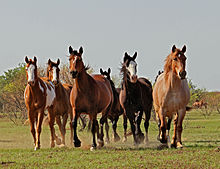
Pocket-size herd of rough stock in Texas.
In spite of pop myth, almost modern "broncs" are non in fact wild horses, but are more commonly spoiled riding horses[ citation needed ] or horses bred specifically as bucking stock.
- Bronc riding – there are two divisions in rodeo, bareback bronc riding, where the rider rides a bucking equus caballus property onto a leather surcingle or rigging with only one manus, and saddle bronc riding, where the rider rides a modified western saddle without a horn (for safety) while belongings onto a braided lead rope attached to the horse'southward halter.
- Bull Riding – though technically not an equestrian event, as the cowboys ride total-grown bulls instead of horses, skills similar to bareback bronc riding are required.
International rodeo [edit]
- Australian rodeo
- Chilean rodeo
- Charreada
Other equestrian activities [edit]
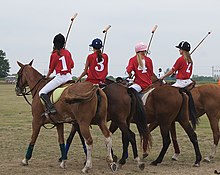
Girls and their horses preparing for a polo game
There are many other forms of equestrian activeness and sports seen worldwide. There are both competitive events and pleasure riding disciplines available.
Arena sports [edit]
- Loonshit polo and Cowboy polo
- Pato (Argentina'due south national sport)
- Equestrian vaulting: In vaulting, a surcingle with two hoops at the top is attached around a equus caballus'due south barrel. The horse also wears a bridle with side reins. The vaulter is longed on the horse, and performs gymnastic movements while the horse walks, trots, and canters.
- Gymkhana, competition of timed design games, also known as O-Mok-See in the western United States.
Horse sports that use cattle [edit]
- Bullfighting (rejoneo)
- Portuguese-manner bullfighting
- Spanish-style bullfighting
- Campdrafting, a blazon of cattle-working competition popular in Australia
- Cutting
- Team penning
- Working moo-cow horse
Defined area sports [edit]
- Buzkashi, a sport originating on the steppes of central Asia, now the national sport of Transitional islamic state of afghanistan and Kyrgyz republic.
- Cowboy mounted shooting
- Horseball
- Jousting and Skill at Arms, events involving utilize of lances, swords and completion of obstacles. At that place are stand-lone competitions and also are often seen at historical reenactments, Renaissance Fairs and Order for Creative Anachronism events.
- Mounted archery
- Yabusame
- Mounted Games, a sport where games are played in a relay-style with two to v members per team at very high speed
- Polo, a team game played on horses, involves riders using a long-handled mallet to drive a brawl on the ground into the opposing team'southward goal while the opposing team defends their goal
- Polocrosse
- Tent pegging
Cantankerous-country sports [edit]
- Competitive Mounted Orienteering, a form of orienteering on horses (but unrelated to orienteering) – consists of three stages: post-obit a precise road marked on a map, negotiation of obstacles and control of paces.
- Le Trec, which comprises three phases – trail riding, with jumping and correct bones flatwork. Le Trec, which is very popular in Europe, tests the partnership's ability to cope with an all-day ride beyond varied terrain, route finding, negotiating natural obstacles and hazards, while considering the welfare of the horse, respecting the countryside and enjoying all it has to offering.
- Competitive trail riding, a pace race held across terrain like to endurance riding, but shorter in length (25 – 35 miles (56 km), depending on course). Being a form of pace race, the objective is non to finish in the least time. Instead, as in other forms of judged trail riding, each competitor is graded on everything including concrete condition, army camp and horse management. Horsemanship also is considered, including how the passenger handles the trail and how horse is handled and presented to the gauge and vet throughout the ride. The equus caballus is graded on performance, manners, etc. "Pulse and respiration" stops cheque the equus caballus'due south recovery ability. The judges also set upwardly obstacles forth the trail and the horse and passenger are graded on how well they perform equally a team. The whole point is the partnership between the horse and rider.
- Cantankerous Country Jumping, a jumping grade that contains logs and natural obstacles more often than not. The mutual clothes worn are usually brighter colors and less conservative.
- Endurance riding, a contest usually of l to 100 miles (160 km) or more, over mountainous or other natural terrain, with scheduled stops to take the horses' vital signs, bank check soundness and verify that the equus caballus is fit to proceed. The first horse to cease and exist confirmed by the veterinarian as fit to continue is the winner. Additional awards are usually given to the best-conditioned horses who finish in the top 10.
- Trick hunting
- Hacking, or pleasure riding.
- Hunter Pacing is a sport where a horse and rider team travel a trail at speeds based the ideal weather condition for the horse, with competitors seeking to ride closest to that perfect fourth dimension. Hunter paces are usually held in a series. Hunter paces are usually a few miles long and covered generally at a canter or gallop. The horsemanship and management skills of the passenger are as well considered in the scoring, and periodic stops are required for veterinarians to check the vital signs and overall soundness of the horses.
- Ride and Tie is a course of endurance riding in which teams of 3 (2 humans and one horse) alternating running and riding.
- Steeplechase, a altitude horse race with various fence and ditch obstacles.
- Trail Riding, pleasance riding any brood equus caballus, whatever style across the state.
Health problems [edit]
Handling, riding and driving horses have inherent risks. Horses are big prey animals with a well-adult flight or fight instinct able to motion quickly and unexpectedly. When mounted, the rider's caput may be up to 4 m (13 ft) from the ground, and the horse may travel at a speed of up to 65 km/h (xl mph).[12] The injuries observed range from very minor injuries to fatalities.
A study in Germany reported that the relative risk of injury from riding a horse, compared to riding a bicycle, was ix times higher for adolescents and 5.six times higher for younger children, simply that riding a horse was less risky than riding a moped.[13] In Victoria, Australia, a search of state records found that equestrian sports had the third highest incidence of serious injury, after motor sports and power canoeing.[14] In Greece, an assay of a national registry estimated the incidence of equestrian injury to be 21 per 100,000 person-years for farming and equestrian sports combined, and 160 times higher for horse racing personnel. Other findings noted that helmets likely prevent traumatic brain injuries.[15]
In the United States each twelvemonth an estimated thirty million people ride horses, resulting in 50,000 emergency department visits (1 visit per 600 riders per year).[16] A survey of 679 equestrians in Oregon, Washington and Idaho estimated that at some time in their equestrian career ane in five will exist seriously injured, resulting in hospitalization, surgery or long-term disability.[17] Amid survey respondents, novice equestrians had an incidence of any injury that was threefold over intermediates, fivefold over advanced equestrians, and nigh eightfold over professionals. Approximately 100 hours of feel are required to achieve a substantial reject in the risk of injury. The survey authors conclude that efforts to prevent equestrian injury should focus on novice equestrians.
Mechanisms of injury [edit]
The most mutual injury is falling from the horse, followed by existence kicked, trampled and bitten. Nigh 3 out of 4 injuries are due to falling, broadly defined.[eighteen] [19] A broad definition of falling oft includes being crushed and existence thrown from the horse, but when reported separately each of these mechanisms may be more than mutual than being kicked.[20] [21]
Types and severity of injury [edit]
In Canada, a ten-year study of trauma center patients injured while riding reported that although 48% had suffered head injuries, only 9% of these riders had been wearing helmets at the time of their blow. Other injuries involved the chest (54%), belly (22%) and extremities (17%).[22] A German study reported that injuries in equus caballus riding are rare compared to other sports, but when they occur they are severe. Specifically, they found that xl% of horse riding injuries were fractures, and only 15% were sprains. Furthermore, the written report noted that in Federal republic of germany, one quarter of all sport related fatalities are caused by horse riding.[23] Most horse related injuries are a result of falling from a horse, which is the crusade of threescore–80% of all such reported injuries.[xviii] [24] Some other mutual cause of injury is being kicked by a horse, which may cause skull fractures or severe trauma to the internal organs. Some possible injuries resulting from horse riding, with the percentage indicating the amounts in relation to all injuries every bit reported by a New Zealand study,[25] include:
- Arm fracture or dislocation (31%)
- Head injury (21%)
- Leg fracture or dislocation (15%)
- Chest injury (33%)
Among 36 members and employees of the Hong Kong Jockey Lodge who were seen in a trauma center during a period of 5 years, 24 savage from horses and xi were kicked by the equus caballus. Injuries comprised: 18 torso; eleven caput, face or cervix; and 11 limb.[26] The authors of this study recommend that helmets, face shields and torso protectors be worn when riding or handling horses.
In New South Wales, Australia, a report of equestrians seen at 1 hospital over a six-year period found that 81% were wearing a helmet at the time of injury, and that helmet utilise both increased over time and was correlated with a lower charge per unit of access.[27] In the second half of the written report flow, of the equestrians seen at a hospital, only 14% were admitted. In contrast, a report of kid equestrians seen at a hospital emergency department in Adelaide reported that sixty% were admitted.[28]
In the United states, an analysis of National Electronic Injury Surveillance System (NEISS) data performed by the Equestrian Medical Safety Association studied 78,279 horse-related injuries in 2007: "The most common injuries included fractures (28.five%); contusions/abrasions (28.three%); strain/sprain (14.five%); internal injury (8.one%); lacerations (5.7%); concussions (four.6%); dislocations (1.9%); and hematomas (1.2%). Most frequent injury sites are the lower body (19.vi%); head (15.0%); upper body (thirteen.4%); shoulder (8.two%); and wrist (6.eight%). Within this study patients were treated and released (86.2%), were hospitalized (viii.7%), were transferred (3.6%), left without being treated (0.8%), remained for observation (0.6%) and arrived at the hospital deceased (0.1%)."[29]
Head injuries [edit]
Horseback riding is one of the nigh dangerous sports, especially in relation to head injury. Statistics from the United states of america, for example, bespeak that about 30 million people ride horses annually.[thirty] On average, about 67,000 people are admitted to the hospital each year from injuries sustained while working with horses.[31] 15,000 of those admittances are from traumatic encephalon injuries. Of those, almost 60 die each yr from their brain injuries.[32] Studies have found horseback riding to exist more unsafe than several sports, including skiing, auto racing and football game.[22] Horseback riding has a higher hospital admittance rate per hours of riding than motorcycle racing, at 0.49 per yard hours of riding and 0.14 accidents per thousand hours, respectively.[22]
Head injuries are specially traumatic in horseback riding. Well-nigh two-thirds of all riders requiring hospitalization later on a fall have sustained a traumatic brain injury.[33] Falling from a equus caballus without wearing a helmet is comparable to being struck by a car.[34] Most falling deaths are acquired by head injury.[34]
The use of riding helmets substantially decreases the likelihood and severity of head injuries. When a rider falls with a helmet, he or she is five times less likely to feel a traumatic brain injury than a passenger who falls without a helmet.[33] Helmets work by crushing on bear upon and extending the length of time information technology takes the caput to stop moving.[35] Despite this, helmet usage rates in North America are estimated to be between viii and xx percent.[36]
In one case a helmet has sustained an impact from falling, that part of the helmet is structurally weakened, even if no visible damage is present.[37] Helmet manufacturers recommend that a helmet that has undergone impact from a fall be replaced immediately. In add-on, helmets should be replaced every three to five years; specific recommendations vary by manufacturer.[38]
Rules on helmet use in competition [edit]
Many organizations mandate helmet employ in contest or on evidence grounds, and rules take continually moved in the direction of requiring helmet use. In 2011, the United states Equestrian Federation passed a rule making helmet apply mandatory while mounted on competition grounds at U.S. nationally rated eventing competitions.[39] Also in 2011, the United States Dressage Federation fabricated helmet employ in contest mandatory for all riders under 18 and all riders who are riding whatsoever test at Fourth Level and below.[xl] If a rider competing at Prix St. Georges and above is too riding a examination at Fourth Level or below, he or she must also wear a helmet at all times while mounted.
Riding astride [edit]

By the 1930s and 1940s most horse riding had become occasional and leisurely or competitive rather than beingness the mutual method of transportation it had been for centuries before
The idea that riding a horse astride could injure a adult female'due south sexual practice organs is a celebrated, but sometimes popular even today, misunderstanding or misconception, particularly that riding astride can damage the hymen.[41] Testify of injury to any female sex organs is scant. In female high-level athletes, trauma to the perineum is rare and is associated with certain sports (see Pelvic flooring#Clinical significance). The type of trauma associated with equestrian sports has been termed "equus caballus riders' perineum".[42] A case series of 4 female person mountain wheel riders and two female equus caballus riders institute both patient-reported perineal pain and evidence of sub-clinical changes in the clitoris;[43] the relevance of these findings to horse riding is unknown.
In men, sports-related injuries are among the major causes of testicular trauma. In a small-scale controlled merely unblinded study of 52 men, varicocele was significantly more mutual in equestrians than in non-equestrians.[44] The difference between these two groups was small, all the same, compared to differences reported between farthermost mountain bicycle riders and non-riders,[45] and too betwixt mountain bike riders and on-road cycle riders.[46] Equus caballus-riding injuries to the scrotum (contusions) and testes (blunt trauma) were well known to surgeons in the 19th century and early on 20th century.[47] Injuries from collision with the pommel of a saddle are mentioned specifically.[47]
Criticism of horses in sport [edit]
Organized welfare groups, such as the Humane Order of the U.s.a., and creature rights groups such as People for the Ethical Handling of Animals, have been known to criticise some equus caballus sports with claims of brute cruelty.
Equus caballus racing is a popular equestrian sport which is practiced in many nations effectually the world. Information technology is inextricably associated with gambling, where in certain events, stakes can become very high. Despite its illegality in most competitions, these conditions of extreme competitiveness can lead to the use of performing-enhancing drugs and farthermost training techniques, which tin result in negative side effects for the horses' well-being. The races themselves take also proved unsafe to the horses – especially steeplechasing, which requires the horse to jump hurdles whilst galloping at full speed. This can result in injury or death to the horse, as well as the jockey.[48] A study by animal welfare grouping Brute Aid revealed that approximately 375 racehorses die yearly, with 30% of these either during or as a consequence of injuries from a race.[49] The written report also highlighted the increasing frequency of race-related illnesses, including bleeding lungs (do-induced pulmonary hemorrhage) and gastric ulcers.[49]
Animal rights groups are besides primarily concerned that certain sports or training exercises may cause unnecessary pain or injuries to horse athletes. Some specific training or showing practices are and then widely condemned that they have been made illegal at the national level and violations can incur criminal penalties. The most well-known is soring, a practice of applying a caustic ointment just to a higher place the hooves of a Tennessee Walking Horse to go far selection upwardly its feet college. Even so, in spite of a federal law in the Usa prohibiting this exercise and routine inspections of horse shows by inspectors from the United States Department of Agriculture, soring is nevertheless widespread and difficult to eliminate.[50] Some events themselves are also considered so abusive that they are banned in many countries. Among these are equus caballus-tripping, a sport where riders chase and rope a loose-running equus caballus by its front legs, throwing it to the footing.[51]
Secondary effects of racing have also recently been uncovered. A 2006 investigation by The Observer in the UK establish that each twelvemonth 6,000–10,000 horses are slaughtered for consumption abroad, a significant proportion of which are horses bred for racing.[52] A boom in the number of foals bred has meant that at that place is not acceptable resource to care for unwanted horses. Demand has increased for this massive breeding program to exist scaled dorsum.[52] Despite over 1000 foals being produced annually past the Thoroughbred horse industry, 66% of those bred for such a purpose were never entered into a race, and despite a life expectancy of xxx years, many are killed earlier their fifth altogether.[52]
Horse riding on coinage [edit]
Equus caballus riding events have been selected as a main motif in numerous collectors' coins. One of the contempo samples is the €ten Greek Equus caballus Riding commemorative coin, minted in 2003 to commemorate the 2004 Summertime Olympics. On the composition of the obverse of this money, the modern horseman is pictured as he jumps over an obstacle, while in the background the ancient horseman is inspired by a representation on a black-figure vase of the 5th century BC.
For the 2022 Olympics, the Purple Mint has produced a 50p money showing a horse jumping a fence.[53]
See also [edit]
- Glossary of equestrian terms
- List of equestrian sports
- Sidesaddle
- Classical dressage
- Equestrian employ of roadways
- Equestrian at the Summer Olympics
- List of equus caballus accidents
- United states of america Equestrian Federation
- International Federation for Equestrian Sports
- Equestrian helmet
- Mounting block
- Cowboy Mounted Shooting
- Fletcher Street Urban Riding Club for a description of urban riding traditions
- Riding hall
- Jinba ittai
References [edit]
- ^ Horse & Hound - 7 Things You lot Need to Know about the Portuguese School of Equestrian Art
- ^ "equestrian – definition of equestrian by the Free Online Lexicon, Thesaurus and Encyclopedia". Thefreedictionary.com. Retrieved 2013-07-01 .
- ^ "equitación – Diccionario Inglés-Español". Wordreference.com. Retrieved 2013-07-01 .
- ^ Leslie, Stephen (2015). Horse-Powered Farming for the 21st Century: A Consummate Guide to Equipment, Methods, and Management for Organic Growers. Chelsea Dark-green Publishing. ISBN978-ane-60358-613-9.
- ^ Chamberlin, J. Edward Horse: How the Horse has Shaped Civilization New York:BlueBridge 2006 ISBN 0-9742405-ix-1
- ^ Bennett, Deb (1998) 'Conquerors: The Roots of New World Horsemanship. Amigo Publications Inc; 1st edition. ISBN 0-9658533-0-6, p. 151
- ^ Nagy, Annamaria; Dyson, Sue; Murray, Jane (18 June 2012). "A veterinary review of endurance riding as an international competitive sport". The Veterinarian Journal. 194 (3): 288–293. doi:10.1016/j.tvjl.2012.06.022. PMID 22819800 – via Elsevier.
- ^ "What is Dressage? – Dressage Academy Training". Retrieved 2020-02-24 .
- ^ [1] Archived May 8, 2013, at the Wayback Auto
- ^ [2] Archived May ane, 2013, at the Wayback Car
- ^ "Equus caballus Bear witness Dress, Attire, Accessories". Hobby Equus caballus Clothing Company, Inc . Retrieved 31 May 2015.
- ^ J R Silver (June 2002). "Spinal injuries resulting from horse riding accidents". Spinal Cord. 40 (vi): 264–71. doi:ten.1038/sj.sc.3101280. PMID 12037707.
- ^ Schneiders W, Rollow A, Rammelt S, Grass R, Holch Yard, Serra A, Richter S, Gruner EM, Schlag B, Roesner D, Zwipp H (April 2007). "Risk-inducing activities leading to injuries in a kid and boyish population of Germany". Journal of Trauma. 62 (4): 996–1003. doi:10.1097/01.ta.0000222584.48001.a0. PMID 17426559.
- ^ Gabbe BJ, Finch CF, Cameron PA, Williamson OD (August 2005). "Incidence of serious injury and death during sport and recreation activities in Victoria, Australia". British Periodical of Sports Medicine. 39 (8): 573–77. doi:10.1136/bjsm.2004.015750. PMC1725286. PMID 16046347.
- ^ Petridou E, Kedikoglou Due south, Belechri G, Ntouvelis Eastward, Dessypris N, Trichopoulos D (March 2004). "The mosaic of equestrian-related injuries in Greece". Journal of Trauma. 56 (3): 643–47. doi:10.1097/01.TA.0000053470.38129.F4. PMID 15128138.
- ^ Carrillo EH, Varnagy D, Bragg SM, Levy J, Riordan K (2007). "Traumatic injuries associated with horseback riding". Scandinavian Periodical of Surgery. 96 (1): 79–82. doi:10.1177/145749690709600115. PMID 17461318. S2CID 27349609.
- ^ Mayberry JC, Pearson TE, Wiger KJ, Diggs BS, Mullins RJ (March 2007). "Equestrian injury prevention efforts demand more attention to novice riders". Journal of Trauma. 62 (3): 735–39. doi:x.1097/ta.0b013e318031b5d4. PMID 17414356.
- ^ a b "Most injuries effect from falls (lxxx%)", Horse riding during pregnancy, MS Rogers.
- ^ R. G. Lloyd (March 1987). "Riding and other equestrian injuries: Considerable severity". British Journal of Sports Medicine. 21 (one): 22–24. doi:10.1136/bjsm.21.i.22. PMC1478604. PMID 3580722.
- ^ Loder RT (Baronial 2008). "The demographics of equestrian-related injuries in the The states: injury patterns, orthopedic specific injuries, and avenues for injury prevention". Journal of Trauma. 65 (two): 447–60. doi:10.1097/TA.0b013e31817dac43. PMID 18695484.
- ^ Clarke CN, Tsuei BJ, Butler KL (May 2008). "Equine-related injury: a retrospective analysis of outcomes over a ten-twelvemonth menses". American Journal of Surgery. 195 (5): 702–04. doi:10.1016/j.amjsurg.2007.11.007. PMID 18424291.
- ^ a b c Brawl CG, Ball JE, Kirkpatrick AW, Mulloy RH (May 2007). "Equestrian injuries: incidence, injury patterns, and risk factors for 10 years of major traumatic injuries". American Journal of Surgery. 193 (5): 636–forty. doi:x.1016/j.amjsurg.2007.01.016. PMID 17434372.
- ^ Dittmer H (1991). "The injury pattern in horseback riding". Langenbecks Archiv für Chirurgie. Supplement. Kongressband. Deutsche Gesellschaft für Chirurgie. Kongress: 466–69. PMID 1793946.
- ^ R. G. Lloyd (March 1987). "Riding and other equestrian injuries: Considerable severity". British Journal of Sports Medicine. 21 (1): 22–24. doi:10.1136/bjsm.21.1.22. PMC1478604. PMID 3580722.
- ^ Northey Chiliad (September 2003). "Equestrian injuries in New Zealand, 1993–2001: knowledge and experience". Northward. Z. Med. J. 116 (1182): U601. PMID 14581953.
- ^ Yim VW, Yeung JH, Mak PS, Graham CA, Lai PB, Rainer TH (Jan 2007). "Five year analysis of Jockey Club horse-related injuries presenting to a trauma heart in Hong Kong". Injury. 38 (1): 98–103. doi:10.1016/j.injury.2006.08.026. PMID 17049524.
- ^ Lim J, Puttaswamy V, Gizzi M, Christie Fifty, Croker W, Crowe P (Baronial 2003). "Pattern of equestrian injuries presenting to a Sydney pedagogy hospital". ANZ Periodical of Surgery. 73 (8): 567–71. doi:10.1046/j.1445-2197.2003.02707.x. PMID 12887517. S2CID 36834081.
- ^ Chicken JA (August 2008). "Paediatric and adolescent horse-related injuries: does the mechanism of injury justify a trauma response?". Emergency Medicine Australasia. 20 (4): 357–62. doi:10.1111/j.1742-6723.2008.01107.x. PMID 18782209. S2CID 963703.
- ^ "Human injuries related to horses analyzed". TheHorse.com. five July 2009. Retrieved 2017-10-28 .
- ^ Deloitte, C (2005). "National economic affect of U.S. horse manufacture". American Horse Council Foundation. Archived from the original on 2010-02-03.
- ^ Loder R (2008). "The demographics of equestrian-related injuries in the United States: injury patterns, orthopedic specific injuries, and avenues for injury prevention". The Journal of Trauma: Injury, Infection, and Critical Care. 65 (2): 447–lx. doi:10.1097/ta.0b013e31817dac43. PMID 18695484.
- ^ "Traumatic Encephalon Injury in Equestrian Sport – Dr Chambless (2d Helmet Safe Symposium)". Riders4Helmets Entrada News. Archived from the original on 29 May 2015. Retrieved 31 May 2015.
- ^ a b Chitnavis JP, Gibbons CL, Hirigoyen Thou, Parry JL, Simpson AH (1996). "Accidents with horses: what has changed in xx years?". Injury. 27 (two): 103–05. doi:10.1016/0020-1383(95)00176-Ten. PMID 8730383.
- ^ a b Nelson MA, Goldberg B, Harris SS, Landry GL, Orenstein DM, Risser WL (1992). "Horseback riding and caput injuries". American Academy of Pediatrics. 89 (iii): 512.
- ^ Clarke CN, Tsuei BJ, Butler KL (2008). "Equine-related injury: a retrospective analysis of outcomes over a ten-twelvemonth period". The American Journal of Surgery. 195 (5): 702–04. doi:x.1016/j.amjsurg.2007.xi.007. PMID 18424291.
- ^ Worley GH (2010). "Promoting the use of equestrian helmets: another opportunity for injury prevention". Periodical of Emergency Nursing. 36 (iii): 263–64. doi:x.1016/j.jen.2010.01.007. PMID 20457328.
- ^ "Helmet Replacement Strategy". 4 Apr 2011. Retrieved 31 May 2015.
- ^ "FAQ's". Retrieved 31 May 2015.
- ^ "New Helmet Rules for Eventing and Dressage Passed at USEF Convention". 27 January 2011. Retrieved 31 May 2015.
- ^ "2011 Rule Changes". The states Equestrian Federation . Retrieved 31 May 2015.
- ^ Dhall A (1995). "Adolescence: myths and misconceptions". Health Millions. 21 (iii): 35–38. PMID 12346860.
- ^ Crepin Yard, Biserte J, Cosson M, Duchene F (October 2006). "[The female person urogenital system and high level sports]". Bull. Acad. Natl. Med. (in French). 190 (7): 1479–91, discussion 1491–93. PMID 17450681.
- ^ Battaglia, C; Nappi, RE; Mancini, F; Cianciosi, A; Persico, N; Busacchi, P (February 2009). "Ultrasonographic and Doppler findings of subclinical clitoral microtraumatisms in mountain bikers and horseback riders". The Journal of Sexual Medicine. 6 (ii): 464–68. doi:x.1111/j.1743-6109.2008.01124.10. PMID 19138367.
- ^ Turgut AT, Kosar U, Kosar P, Karabulut A (July 2005). "Scrotal sonographic findings in equestrians". Journal of Ultrasound in Medicine. 24 (7): 911–17, quiz 919. doi:10.7863/jum.2005.24.7.911. PMID 15972705. S2CID 44339283.
- ^ Frauscher F, Klauser A, Stenzl A, Helweg G, Amort B, zur Nedden D (May 2001). "U.s. findings in the scrotum of extreme mountain bikers". Radiology. 219 (2): 427–31. doi:10.1148/radiology.219.2.r01ma42427. PMID 11323467.
- ^ Mitterberger Yard, Pinggera GM, Neuwirt H, Colleselli D, Pelzer A, Bartsch G, Strasser H, Gradl J, Pallwein L, Frauscher F (January 2008). "Do mount bikers have a higher risk of scrotal disorders than on-road cyclists?". Clinical Journal of Sport Medicine. 18 (1): 49–54. doi:ten.1097/JSM.0b013e31815c042f. PMID 18185039. S2CID 29581763.
- ^ a b William Williams Slap-up; John Chalmers Da Costa, eds. (1908). Surgery, Its Principles and Do. Vol. 4. Philadelphia and London: West. B. Saunders Company. pp. 598, 615
- ^ "Should steeplechases exist banned?". BBC News. 2000-04-17.
- ^ a b "Bred To Death: Background Notes". Creature Aid. Archived from the original on 2013-05-10. Retrieved 2013-07-01 .
- ^ "EQUUS Special Report: Why Soring Persists". Archived from the original on 9 September 2014. Retrieved 31 May 2015.
- ^ [3] Archived March 15, 2013, at the Wayback Machine
- ^ a b c Barnett, Antony (2006-x-06). "The slaughtered horses that shame our racing". The Guardian.
- ^ "London 2022 50p Sports Collection – Equestrian". Retrieved 31 May 2015.
External links [edit]
- International Federation for Equestrian Sports FEI official homepage
- United States Equestrian Federation USEF Official web site
- Equestrian Federation of Australia Equestrian Federation of Australia web site
- Equestrian Federation of Ireland – EFI web site
- Equestrian Federation of Republic of kazakhstan Russian – Equestrian Federation of Kazakhstan English
- Us Dressage Federation
- American Endurance Ride Conference
- The North American Trail Ride Briefing – Competitive Trail Riding
- United kingdom Endurance Horse Riding
- Ride and Tie Association
- The American Vaulting Association – Equestrian Vaulting
- Danish Riding Federation
- National Cut Horse Association
Source: https://en.wikipedia.org/wiki/Equestrianism

Post a Comment for "Where Can I Go Horseback Riding Near Me"