Shirley Temple - the Disturbing History of Baby Burlesk Reddit
The Tragic Real-Life Story Of Shirley Temple
Hulton Archive/Getty Images
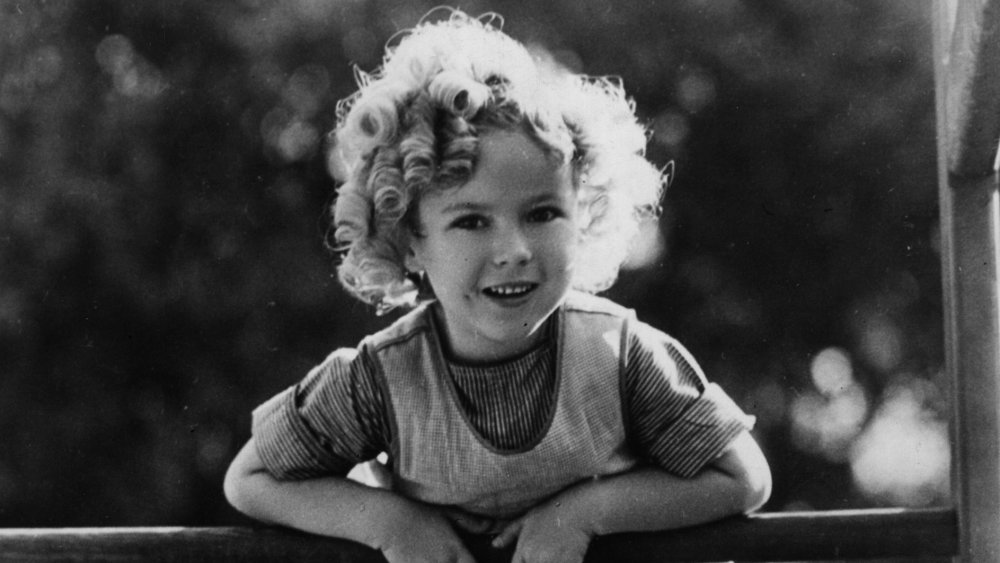
Few child stars have e'er achieved the level of glory that Shirley Temple had. She was a worldwide phenomenon who inspired dresses, dolls, and even a drink. Nicknamed "America's little darling" and "Little Miss Miracle," she became a symbol of optimism at a time when the Us was reeling from the Slap-up Low. And when the public lost interest in her equally an amusement performer, Temple tailored her performances into politics and devoted herself to social service and international diplomacy for nearly 30 years.
Despite the glitz and glamour of evidence business concern, Shirley Temple'southward life wasn't every bit carefree as many assumed. Fans would ask if her hair was real and defendant her of being a fake kid. Temple also oft had to resist the advances of studio executives and older men in the entertainment manufacture. And even though Temple made more than $iii meg during her interim career, she ended losing about of her total earnings due to her parents' poor financial decisions, per TV Guide.
Ultimately, Temple defied all expectations and went on to become ane of the most successful child stars of all time, on and off the screen. Simply beneath the dimpled smile was just a young daughter who ended upwards putting up with much more than she e'er should've. This is the tragic real-life story of Shirley Temple.
Shirley Temple's career began at age four
Hulton Archive/Getty Images
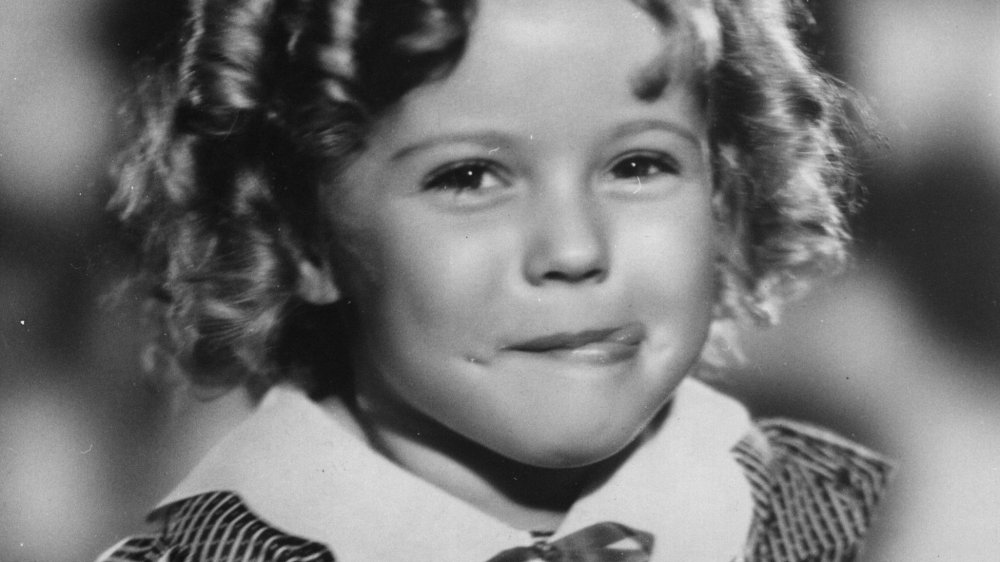
Born on Apr 23rd, 1928, Shirley Jane Temple was just three years quondam when her female parent, Gertrude, perceptive of Temple's burgeoning talent, signed her upward for dance lessons. But the decision wasn't entirely selfless. Gertrude herself had wanted to get a dancer and was intent on her daughter succeeding where she had failed. According to Biography, it was at the dance school that Temple was discovered past producers from Educational Films Corporation.
Despite the proper noun, the shorts fabricated by the film distribution visitor were oriented more than towards the comedic than instructional. In 1932, Temple was bandage in a series of shorts called "Baby Burlesks," where children played the satirized roles of adults. Temple'due south first speaking role occurs in the 2nd "Baby Burlesks" short titled "War Babies," where Temple plays an exotic dancer equally toddlers in diapers ogle her. Her first on-screen kiss came occurred when Temple was but 5 years old.
According to The Atlantic, the set of "Babe Burlesks" wasn't the kindest place for children. If anyone misbehaved, they were sent to sit on a block of ice in a black sound berth. While Temple later wrote in her autobiography that she didn't think that the blackness box did any permanent harm to her psyche, "its lesson of life, however, was profound and unforgettable. Time is money. Wasted time means wasted coin ways trouble," every bit quoted in the Washington Post.
The early films of Shirley Temple
Hulton Archive/Getty Images
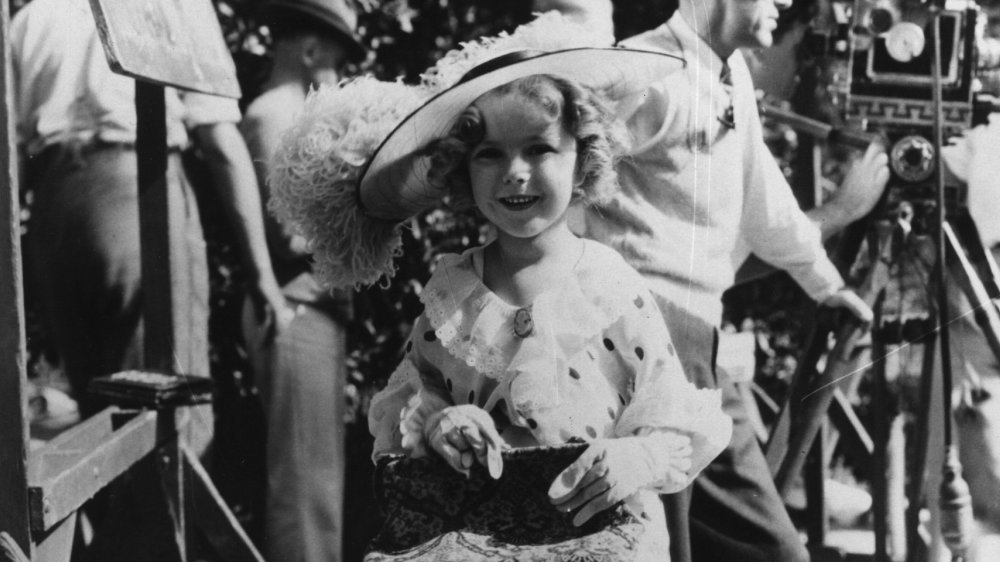
Shirley Temple'southward roles in "Baby Burlesks" caught the eye of Fox Moving-picture show Corporation, which would later merge with Twentieth Century Pictures in 1935 to create 20th Century-Fox. According to Newsweek, afterwards songwriter Jay Gorney saw an episode of Frolics of Youth, another multi-part series produced past Educational Pictures that Temple appeared in. Gorney was struck when he saw Temple entertaining fans in a movie theatre lobby as he left the screening. He was so charmed by her that he promptly arranged for Temple to audition for the film Stand Up and Cheer! in December 1933. She quickly got the part and was signed to a "two-calendar week guaranteed, $150-per-calendar week contract." By the stop of the month, her contract had been given a year extension equally well as an option for seven years.
According to Encyclopedia Britannica, Stand up and Cheer!, which came out in 1934, was Temple'southward first major flick. And by the end of the yr, she'd been given a starring role in Fiddling Miss Marker as well. She appeared in a number of other films in 1934, but the musical Bright Eyes is considered to be the film that made her such a celebrity. Vivid Eyes was written specifically for Temple and in information technology, she sang what became her most pop vocal, "On the Good Ship Lollipop."
Temple was one of Hollywood's greatest box office attractions
Hulton Archive/Getty Images
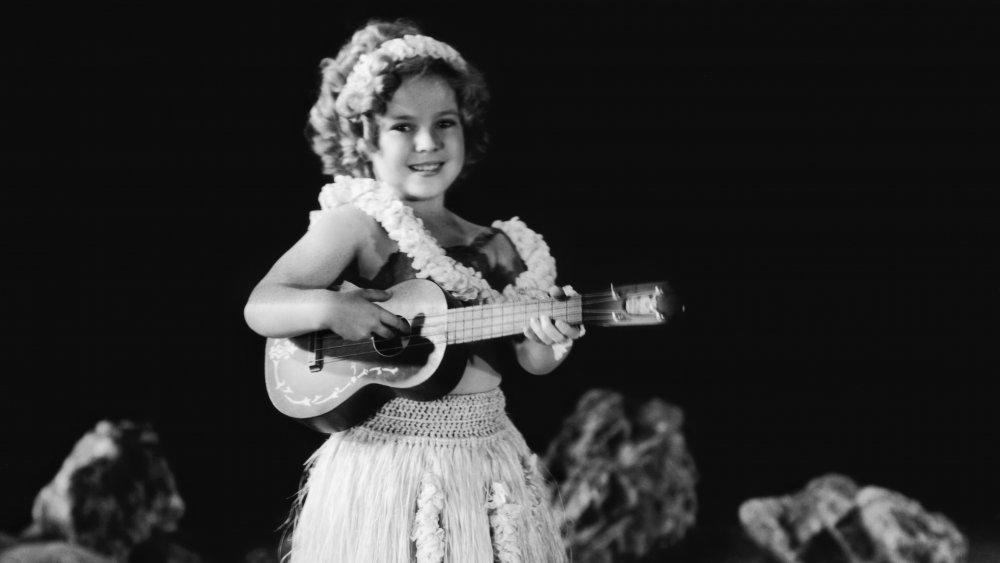
Between 1935 and 1938, Shirley Temple was Hollywood's pinnacle box-office allure, chirapsia out stars such every bit Bing Crosby and Clark Gable, per Democrat & Relate. According to Newsweek, her moving-picture show Curly Tiptop, which came out in July 1935, made $1.1 million at the box office. According to the BBC, Temple is even credited with keeping 20th Century Fox from bankruptcy, especially due to the success of the movie Bright Eyes.
In the midst of the Not bad Low, President Franklin D. Roosevelt even credited her with raising people'due south spirits, referring to Temple every bit "Picayune Miss Phenomenon," CNN notes. Dickie Moore, another child star of the time, said that Temple could "make people believe, if simply for 90 minutes, that there were no problems in the globe."
Temple appeared in at least three movies a year between 1935 and 1938, sometimes upwardly of eight, often playing an orphan whose optimism was reassuring to audiences during a fourth dimension of economical turmoil and uncertainty. According to The Little Girl Who Fought the Great Depression by John F. Kasson, the low-cal-hearted comedy of Temple's films was not meant to "modify the world but to summon the emotional resources simply to persevere in it. In all her 1930s movies beginning with Stand Upward and Cheer!, Shirley Temple helped them to exercise then."
A juvenile award for Temple
In 1935, Temple'south office in Bright Optics earned her an Academy Award. According to Good Housekeeping, Temple both received and presented an accolade at the seventh Annual Academy Awards, but the honour she received was the very first of its kind.
According to Atlas Obscura, Temple was awarded the very kickoff Juvenile Academy Accolade "in grateful recognition of her outstanding contribution to screen entertainment in 1934," per Oscar.org. The Juvenile Oscar was created so that child performers wouldn't take to compete confronting grown-ups and were awarded to those aged betwixt six and xviii. The Oscar could be awarded for a item film, or for general work over the twelvemonth, every bit was done with Temple.
The Juvenile Oscars themselves were roughly one-half the size of the adult Oscars. And according to The New Yorker, Temple criticized the shrunken Oscar in her autobiography, noting that, "Someone's cute idea to lucifer my height with a shrunken Oscar badly misfired. If mine was really a laudable job well-washed, why not a big Oscar like anybody else'due south?"
The final Juvenile Oscar was awarded in 1961 to Hayley Mills for Pollyanna. After 16-year-old Patty Duke won Best Supporting Actress in 1963, the Oscar committee decided that the Juvenile Oscar was no longer necessary. Coincidentally, the last Juvenile Oscar was presented past Temple, the first Juvenile Oscar winner.
Shirley Temple gets merchandised
Imagno/Getty Images
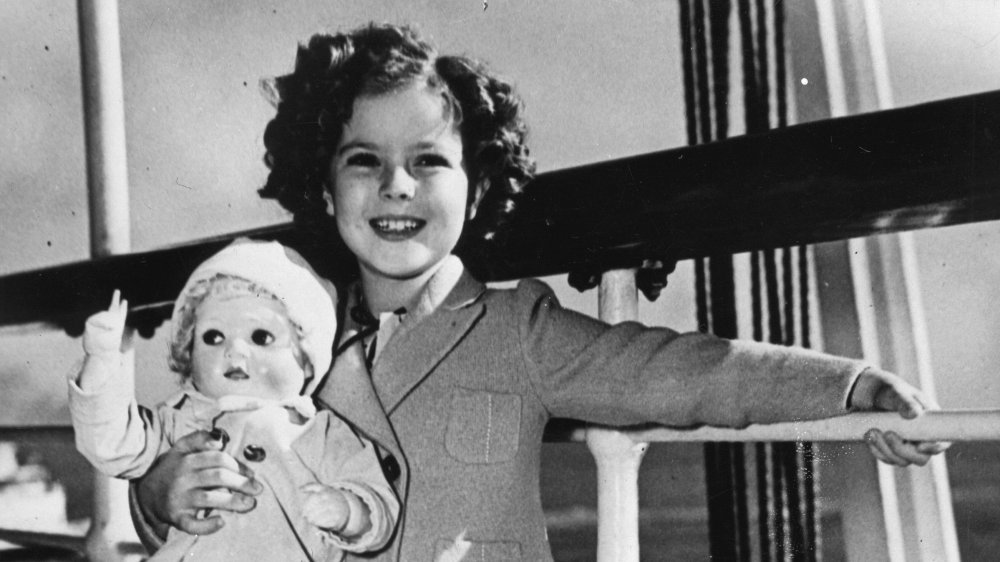
Temple's popularity led to many products being created in her name and likeness. According to Fashion Historia, Temple-themed merchandise included raincoats, dresses, and accessories. There was as well a Shirley Temple doll made by the Platonic Novelty and Toy Visitor. Co-ordinate to Collectors Weekly, the doll was officially appear in October 1934 and came outfitted in a polka-dotted dress similar to the once worn by Temple in Stand Up and Cheer!. In 1935, the Shirley Temple doll accounted for nearly one-third of all doll sales, even though information technology cost 3 times every bit much as unlicensed dolls. Her iconic hairstyle was too imitated by many.
And while there are conflicting accounts of the drinks origin, the Shirley Temple drink is besides named after the kid star. Merely funnily enough, Temple herself wasn't a fan of the drink, saying that information technology was too sweet for her taste. Temple also turned downwards many offers to license her name for the mocktail, noting that she doesn't like the thought of cocktails, even non-alcoholic ones, for children.
By 1935, Temple was making $1,000 a week just from merchandising and by 1936, her royalties from licensing exceeded $200,000.
Shirley Temple's finances
Imagno/Getty Images
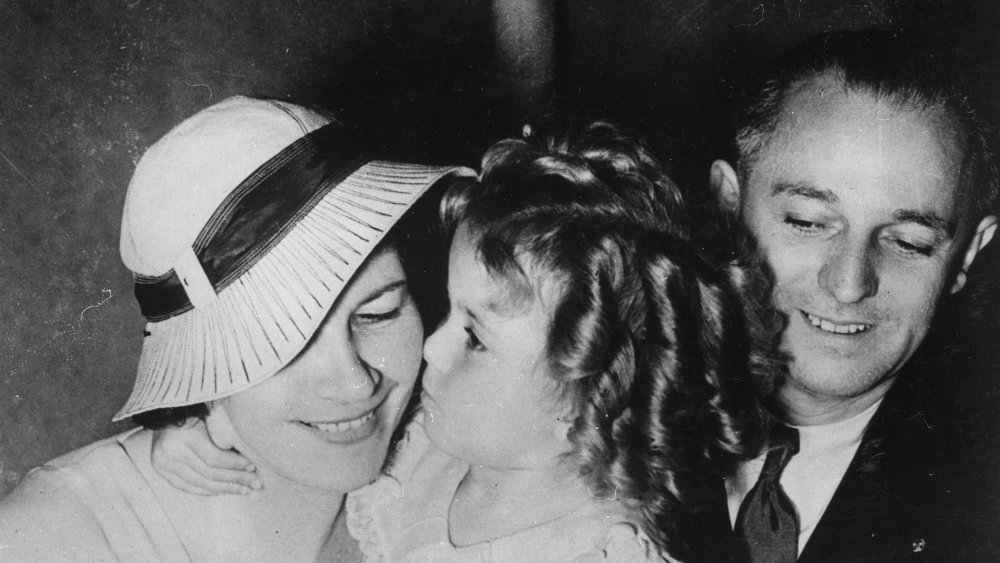
Despite the fact that Shirley Temple was making a great deal of money, she didn't end up seeing much of information technology. After Temple had signed her studio contract in 1934, her male parent George became her manager. And although he fought repeatedly for pay increases, it was more for his benefit than his girl's.
According to Newsweek, by the terminate of 1935, Temple'south salary was $2,500 per week, and in 1936, information technology rose to $50,000 per movie. According to The Atlantic, in 1938, at $307,014, Temple was making more money in a yr than anyone else in Hollywood other than Louis B. Mayer, one of the co-founders of MGM. Merely despite the money coming in from merchandising and movies, when Temple was 22, she discovered that fifty-fifty though she had earned over three 1000000 dollars, she reportedly had $44,000 in her account.
With the spending of her parents and her father's mismanagement of her wealth, Temple was left with a fraction of the fortune she had earned. But despite everything, Temple later wrote that "for reasons some of you may discover inexplicable, I felt neither disappointment nor anger."
Struggling against rumors and producers
Imagno/Getty Images
Shirley Temple was regularly treated poorly during her flick career. During the 1932 filmRunt Page, Temple got an ear infection and had to have her eardrum lanced at a infirmary. And despite her mother's pleading, the producer insisted that Temple be at the studio in the morning or she would be replaced.
Co-ordinate to The Atlantic, Temple likewise had to frequently fend off advances from men. During her first visit to MGM, the producer Arthur Freed unzipped his fly in front of Temple. When she was 17, producer David O. Selznick also literally chased her effectually an office, "expecting his 'due' every bit her dominate," per Newsner. In 1939, a woman also tried to assassinate Temple because she believed that Temple had stolen her girl'due south soul.
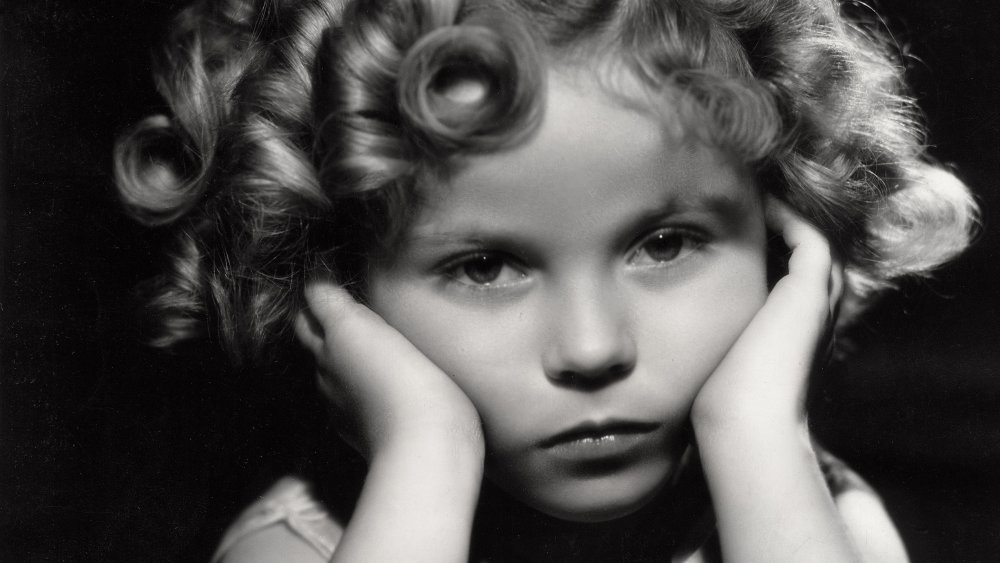
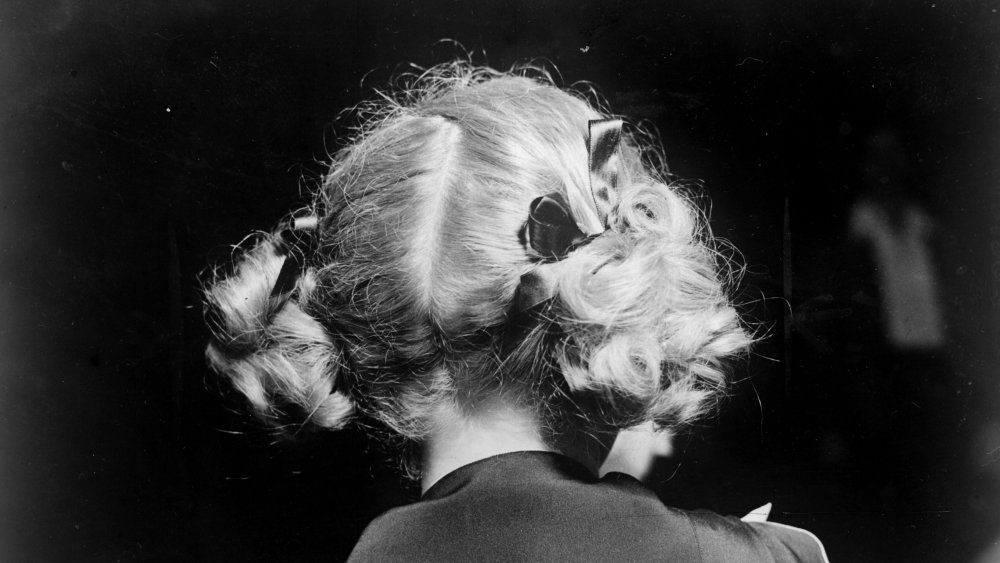
Temple was also plagued by various rumors, such as that her hair wasn't real or that she wasn't really a child. Some fifty-fifty claimed that her teeth had been filed to appear more like baby teeth. Oft, fans would pull on her hair to cheque if it were a wig or not, according to Refreshing Life. Temple herself wished that she had been able to wear a wig since her existent hair warranted nightly rituals that included a weekly vinegar rinse that caused her optics to burn. The rumor that she wasn't actually a child was so widespread that the Vatican sent Male parent Silvio Massante to investigate Temple'southward true age, per The Hollywood Reporter.
Temple takes a suspension from movies
Hulton Archive/Getty Images
Shirley Temple's popularity began to wane equally she grew upwards and matured. According to The Atlantic, Temple had already "started to historic period out of commercial viability" at but 12 years old. Afterwards 1 of her movies, The Blue Bird, did poorly in the box-office in 1940, Fox dropped her contract, and although she then signed with MGM, she never made another striking like the ones from her childhood.
According to CNN, during this time Temple started going to school over again in Los Angeles and began to focus on a not-glory life. As she connected her schooling, Temple continued to appear in various films throughout the 1940s such equally That Hagen Girl and The Bachelor and the Bobby Soxer, but despite receiving critical praise, none were box part successes. Her final flick, A Buss for Corliss, came out in 1949, and information technology also received a lukewarm reception.
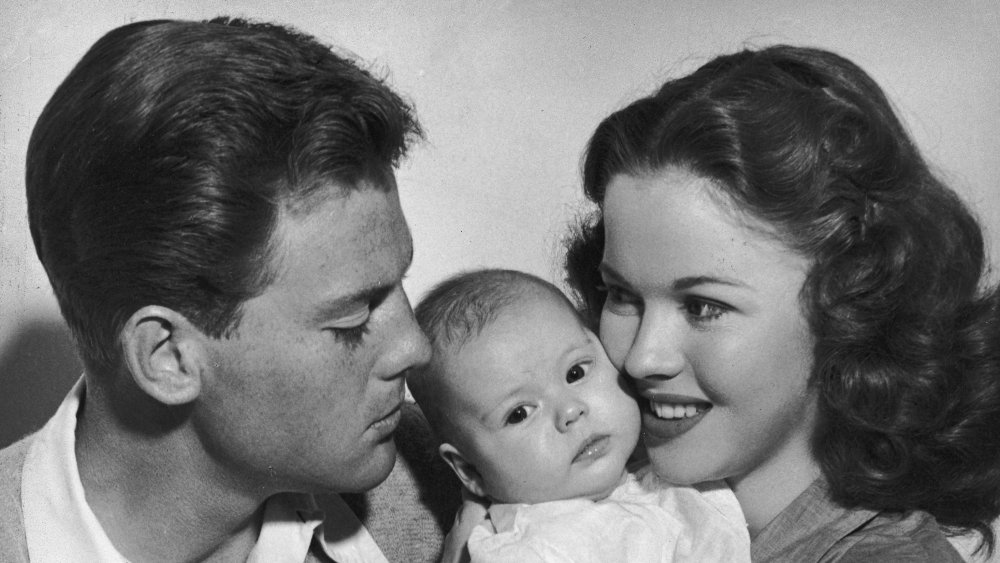
Temple had married young man actor John Agar in 1945, hoping that he could help protect her from the muddled life of Hollywood, but instead Agar turned out to exist a violent alcoholic who simply added to Temple'southward troubles, per The Life and Times of Hollywood. They divorced a few years later, in 1949, but Temple's divorce added to her "adult" image. "'Little Miss Miracle' was growing upwards," as Biography put it.
Finding it more than and more difficult to land major roles, Temple stepped abroad from the big screen.
Temple made a brief pin to television
Hulton Archive/Getty Images
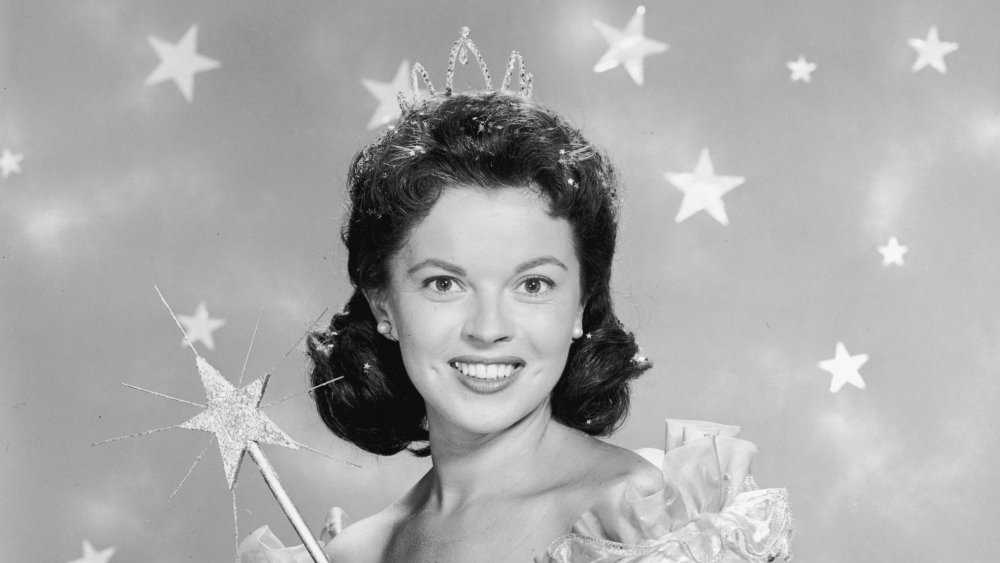
After taking a break from films to focus on maternity, Temple returned to the entertainment manufacture in the 1950s, though this time on a smaller screen. From 1957 to 1959, Temple hosted a tv testify titled "Shirley Temple's Storybook," an anthology serial that retold classic fairy tales. Temple'southward 3 children even appeared in the last episode of the first season, "Female parent Goose."
According to Women's History, although the evidence didn't have a long run, Temple over again inspired a line of trade that included coloring books, dolls, and handbags. And although ABC Telly dropped "Storybook" in 1960, the program was picked up by NBC TV and renamed "The Shirley Temple Prove." Unfortunately, the prove was considered less successful than its ABC version and was canceled by NBC in 1961. Notwithstanding, in the terminate, NBC broadcasted over twoscore episodes.
But past the mid-1960s, Temple decided to put her entertainment career behind her and started focusing on politics.
Shirley Temple's diplomatic career
William Lovelace/Getty Images
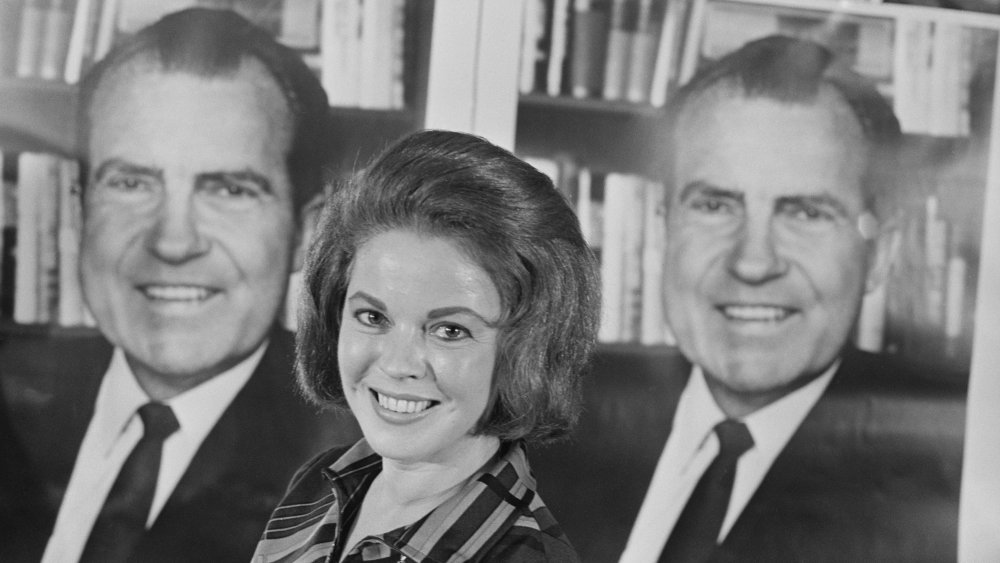
After Shirley Temple married Charles Alden Black and they moved to Washington D.C. for his career, Temple started working as a Republican fund-raiser, per Smithsonian Magazine. In 1967, Temple turned her full attention to politics and entered the congressional race in California. Although she ultimately lost, her political career was simply just beginning.
Temple was a lifelong fellow member of the Republican Party and campaigned for Richard Nixon in 1968. According to Biography, Temple served as a United states of america ambassador to the United Nations from 1969 to 1970 under President Nixon. President Gerald Ford also appointed Temple as the U.s.a. Administrator to Ghana from 1974 to 1976.
Her political piece of work continued when in 1976, Temple became the starting time woman to be United States chief of protocol at the Land Section, serving until 1977 under President Ford. President Ford even joked that her loss in the congressional race was a blessing that allowed her to exercise diplomatic piece of work, stating that she had "been then successful in the latter, it's probably meliorate that [she] didn't win it earlier."
In 1988, Temple was given the get-go honorary title of "Foreign Service Officer" in recognition of her work as a diplomat. Temple too worked aslope her old co-star Ronald Reagan, with whom she had starred in 1947'sThat Hagen Girl, as a foreign affairs officer-expert while he was president.
Temple was likewise appointed by President George H.W. Bush equally the ambassador to Czechoslovakia from 1989 to 1992, during which time she primarily lived in Prague.
Shirley Temple raised awareness for chest cancer
Victor Blackman/Getty Images
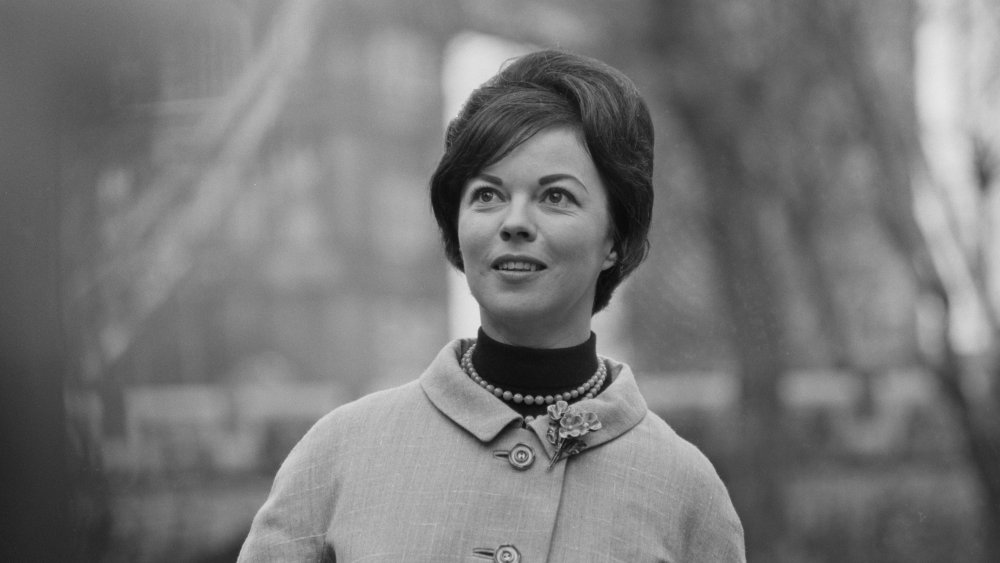
At the time when Shirley Temple was diagnosed with chest cancer in 1972, the illness was rarely talked about, especially in public. Celebrities at the time also oft hid their illnesses from the public. But Temple sought to dispel the stigma and shame around breast cancer, so when she underwent a mastectomy, she spoke to reporters directly from her hospital bed, every bit the New York Times reported.
According to Groovy History, while she was recovering in the hospital, Temple explained to reporters how a malignant lump had been discovered in her left breast and that the chest had to be removed every bit a result. Non merely was information technology uncommon for a glory to be so candid about their affliction and its treatment, the openness with which Temple discussed her chest cancer diagnosis was as well aimed at providing information to women that doctors at the time weren't necessarily giving.
At the time, informed consent also wasn't common, and many women who thought they were just having a biopsy would wake upwardly to observe that they'd undergone a radical mastectomy, since doctors "causeless the entire brunt of deciding how patients with breast cancer should exist treated," co-ordinate to Dr. George Crile in a 1972 medical certificate. Simply as Temple advocated for cocky-examinations, Temple became an outspoken abet for women'south agency in regards to their health.
Shirley Temple's afterward life and decease
London Express/Getty Images
Shirley Temple was appreciated across political party lines, and in 1998, President Clinton awarded her the Kennedy Eye Honors in recognition of her years of diplomatic service. Later on her work in politics, Temple went on to serve on the board of directors for a number of organizations, not limited to Bank of America, The Walt Disney Company, and the National Wildlife Federation.
In 2006, she was too awarded the Screen Actors Order Lifetime Achievement Award. Even though Temple'southward film career lasted roughly 20 years, she made an unforgettable impression. Her husband, Charles Black, had died the year before, so their son accompanied her to the awards ceremony.
Temple didn't distinguish much between her entertainment career and her political career during her life, claiming once that, "Politicians are actors too, don't you think?" per CSMonitor. And for her, the years she spent in Hollywood were just as enjoyable as her years in social service.
On Feb 10th, 2014, Shirley Temple died from pneumonia and chronic obstructive pulmonary affliction (COPD) at the age of 85. She was survived past her 3 children.
Source: https://www.grunge.com/266469/the-tragic-real-life-story-of-shirley-temple/

Post a Comment for "Shirley Temple - the Disturbing History of Baby Burlesk Reddit"